Showing posts with label Spanish. Show all posts

Friday, July 3, 2026

Battle of Ocaña (19 November 1809)

Refight of the Battle of Ocaña, 19th November 1809, using Commands & Colors Napoleonic Rules. Figures from Baccus 6mm range, hex terrain from Kallistra, houses from TBM and trees from Timecast.

Although the Battle of Ocaña is without a doubt the French army's greatest victory in Spain, it has been rarely written about. As a matter of national pride, Spanish historians could hardly be expected to tackle the subject. From a French point of view, the wars were Napoleonic, and as Napoleon wasn't present there was little interest. As for the British, they neglected the battle as none of their troops were present.  There is now however, an interesting work in English covering the battle: “The Battle Of Ocaña – the Army of Spain’s Greatest Victory by Pierre Juhel".


The History:

The Spanish campaign of fall 1809 was unfolding successfully. The subsidiary Army of the Left had beaten the French at Tamames. Now the 55,000 man Army of La Mancha commanded by Juan de Aréizaga was a mere 35 miles from Madrid. The French were reacting quickly and soon assembled over 30,000 troops, with more approaching to cut off the Spaniards. Aréizaga realized the threat and began to fall back, but not quickly enough. The French army, under the tactical command of Marshal Soult, brought the Spanish army to bay near the village of Ocaña where it deployed in terrain unfavourable for the defence. The Spanish centre and right were formed on an open plain – excellent terrain for the French cavalry. On the 19th Soult ordered Sebastiani to attack the Spanish right flank infantry with his German and Polish divisions. When the infantry was fully engaged, Milhaud’s French cavalry attacked Freire’s cavalry, severely battered in the previous day’s cavalry battle, and quickly routed the Spanish horse. Meanwhile the Spanish were funnelling reinforcements to the right and began to press back Sebastiani’s troops. The Spanish advantage was only temporary. Soon the victorious French cavalry, including the feared diablos Polacos (the Polish Vistula Legion lancers), fell upon the rear of the Spanish right flank infantry. In minutes three Spanish divisions ceased to exist.

Marshal Soult advanced infantry on the newly exposed Spanish center divisions, pinning them in place. Soon the French cavalry descended on these troops too, scattering them to the wind. Dessolles’ division then stormed Ocaña, and all remaining Spanish formations fled except for Zayas’ division. It attempted to cover the Spanish retreat, and retained its formation for several miles, but it too collapsed later in the day to a French cavalry pursuit that could not be stopped. Over 5,000 Spaniards were casualties and another 14,000 were captured, along with virtually all of the army’s artillery.


The Setup:

The armies deployed on what was basically an open plain in front of the village of Ocaña,


The view from the Spanish commander's lines:

The village of Ocaña, heavily defended by Spanish infantry. Houses are TBM and the statue is a Baccus SYW general.


The Refight:

The battle started with some infantry skirmishing on the French left flank.

The French commander then ordered an assault on his left flank with the primary objective to eliminate the Spanish right flank cavalry and a secondary objective to attack the Spanish infantry.

The Polish lancers first rode down and eliminated the Spanish Dragoons and then broke through and charged into the Spanish light cavalry eliminating them too.

This left the French dragoons free to attach the Spanish line infantry. They decided not to form square, which proved to be a fatal mistake.

The advancing French infantry were less successful, exchanged volleys and casualties with the Spanish light infantry.

Polish Vistula Legion lancers charging the Spanish Regimiento de Dragones de Almansa

The French commander then ordered a Cavalry Charge. The Spanish guerrillas tried to intercept the order but were cut down with sabres in the attempt.

The French dragoons charged the Spanish infantry who formed square with both sides taking casualties.

The Polish Lancers destroyed the Spanish artillery and forced the Spanish Grenadiers behind them to also form square.

«Los Diablos Polacos» The Polish Devils were living up to their nickname, as their charged and wiped out the Spanish artillery.

With 3 infantry units now in squares, the Spanish commander was greatly limited in his ability to manoeuvre. 

While the French dragoons kept the Spanish infantry in squares, the French line and light infantry moved forward to support the Polish lancers. Now the artillery could come into play, supporting the lancers and infantry in combined arms attacks. The Spanish grenadiers in square were the first target of this tactic.

The whole Spanish right wing was decimated.

The troops holding Ocaña and those in reserve, were so dispirited and demoralised by the speed of their right wing's slaughter, that they had no desire to stand and remain in the fight.  

This resulted in a 6-0 victory to the French.


Monday, March 18, 2024

Medellín (28 March 1809)

This scenario is a refight of the Battle of Medellín (28 March 1809) during the Peninsular War. It was played using the Commands & Colors Napolionic rules but on hex terrain from Kallistra, buildings from Total Battle Miniatures and using 6mm figures from Baccus instead of blocks.


The History

After being forced out of its defensive positions on the River Tagus, General Don Gregorio Garcia de la Cuesta’s Spanish army was retreating in the face of Marshal Victor’s advancing French army. On the 27th of March, Cuesta’s army was reinforced by the Duke of Albuquerque, and Cuesta decided it was time to fight. Cuesta’s plan was to strike both French wings and hope to catch the French army with their backs to the Guadiana River. Victor was outnumbered, but had veteran troops who knew how to win, so he willingly deployed for battle. Victor’s plan was to keep withdrawing his flanks closer and closer to the center until a powerful counter-attack could shatter the Spanish line.

Cuesta formed his infantry into one long, thin unbroken line since his greatest fear was that French cavalry could destroy his infantry if there were gaps in the line. At first, Cuesta’s plan seemed to be working. Lasalle’s position on the French left was at risk, but his men held on to their tenuous positions. Spanish infantry formations were also pushing forward against the French batteries on Latour-Maubourg’s hill position. Latour-Maubourg flung his cavalry into a counter attack, but the cavalry was forced into a disorganized retreat. As the Spanish infantry threatened to capture the French guns, Latour-Maubourg ordered his reformed cavalry to attack again – this time against the Spanish cavalry covering the end of the infantry line. Events now unfolded quickly. The French cavalry charge succeeded and the Spanish cavalry fled the field, exposing the thin Spanish line to a devastating flank attack. Cuesta’s left flank dissolved in panic. Lasalle and Villatte, seeing the opportunity, ordered a counter-attack that caught the right flank of the Spanish army between infantry to their front and cavalry to their flanks and rear.

The result was a massacre. Entire battalions were destroyed as they tried to stand and fight, and the French cavalry showed no quarter in their pursuit of fugitives. Over 7,500 Spaniards became casualties. In the aftermath, Cuesta’s shattered army retreated to Monasterio.


The Refight

The Spanish started the battle by repositioning their infantry on the central ridge to make room for a battery of foot artillery, moving forward so as to be in a good position to bombard the French.

Marshal Victor ordered La Grande Manoeuvre and moved his left flank over to face the Spanish centre. By doing so, he got his troops out of a tricky situation, as they had had their backs to the unfordable Guadiana River.

General Don Gregorio Garcia de la Cuesta ordered both his flanks forward.

On his left, Spanish line infantry and Heavy Dragoons advanced. Perhaps hoping to surprise the French right, or perhaps just to secure the town of Mengabril.

While on the Spanish right, the troops moved towards the centre, to mirror the French manoeuvre.

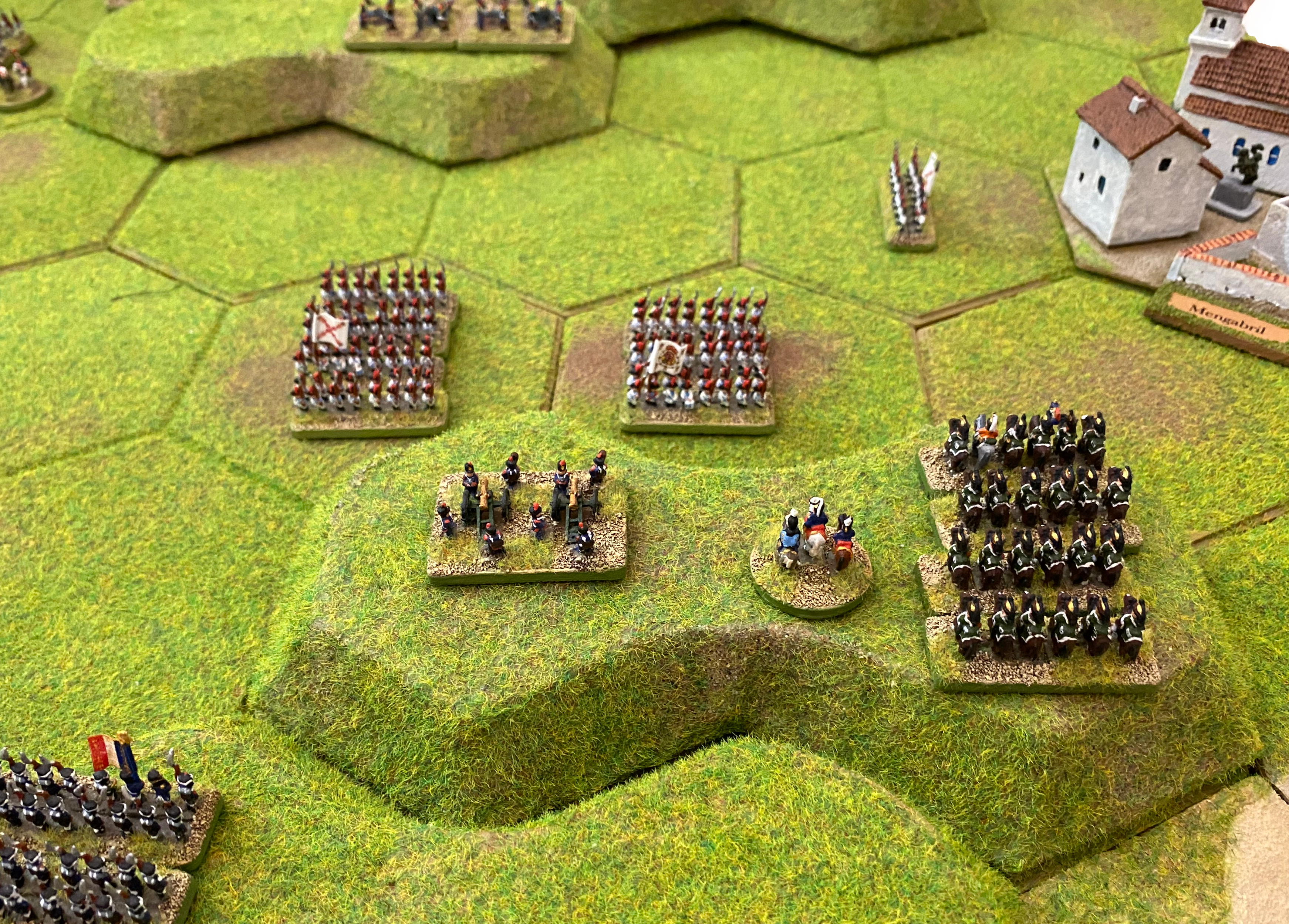
Marshal Victor ordered his right flank to assault the advancing Spanish. General Latour-Maubourg took command of the Dragoons, and supported by their horse artillery, they attacked the Spanish Dragoons. While French infantry advanced to fill the gap they had left in the line.

Charging down the hill, with the supporting cannon fire from their horse artillery, Latour-Maubourg's Dragoons wiped out their Spanish counterparts.

The Spanish Force Marched their left wing infantry commanded by Brigadier Juan Henestrosa to oppose the advance of the French right wing.

Marshal Victor was about to order his troops forward, however troublesome Spanish Guerrillas delayed his chief of staff from sending out the command.

Taking advantage of the apparent hesitation of the French, General Cuesta ordered his left flank to attack.

Musket fire from the Spanish line infantry caused severe losses to the French horse artillery causing it to retire behind the crest of the hill.

However the Spanish infantry's attack on the French Dragoons was less successful, resulting in heavy losses for the Spanish infantry and the death of Brigadier Juan Henestrosa and no noticeable effect on the French.

The French centre was ordered to attack. One light cavalry unit charged a Spanish infantry unit and a second light cavalry unit moved up in support.

The Spanish infantry formed square, creating a temporary stand-off.

Showing inspired leadership, General Trias led his Spanish infantry unit through the valley between the hills in order to attack and push back the French cavalry.

On the French right, the horse artillry advanced again and the Dragoons attacked the Spanish infantry in front of the town of Mengabril, The Spanish infantry formed square, repulsing the Dragoons.

Seeing the success of their comrades, the remaining Spanish infantry attacked the French on the hill.

The first attacking Spanish line infantry column was repulsed by the French horse artillery, causing it to retreat back to the ridge after taking losses. The second attacking column caused the French artillery to retire behind the crest of the hill, but did not follow up its victory.

The French ordered their centre to attack. Two units of light cavalry rode forward to attack the Spanish positions.

When the cavalry attack was over, one cavalry unit was destroyed and one had retired. However both Spanish line infantry units had severe losses.

Back on their left flank, the Spanish infantry climbed up the hill and attacked the French horse artillery.

The horse artillery was destroyed.

The Spanish light cavalry advanced, causing the French light cavalry to retreat to their own lines having taken severe losses.

On the French right, the dragoons advanced to attack the Spanish artillery while a line infantry column advanced over the crest of the hill.

The dragoons rode passed the decimated Spanish square, which the line infantry opened fire on and destroyed.

The dragoons attacked the artillery on the hill.

General Latour-Maubourg and his dragoons caused serious casualties and only a few surviving Spanish artillerymen managed to retreat.

The dragoons followed up the attack and overran the few surviving Spanish artillerymen.

General Latour-Maubourg and his victorious French Heavy Dragoons...

Having taken heavy losses, and their left flank turned by the French heavy cavalry, the whole Spanish army gave up the battle and started to fade away and head for the sierras.


The Outcome 

Spanish Victory:   Spanish 6 - French 3


Sunday, September 24, 2023

Gamonal (10 November 1808)

This scenario is a refight of the Battle of Gamonal (10 November 1808) during the Peninsular War. It was played using the Commands & Colors Napolionic rules but on hex terrain from Kallistra, buildings from Total Battle Miniatures, trees mostly from Timecast Miniatures and using 6mm figures from Baccus instead of blocks. This is the sixth battle using our Peninsular War campaign rules.


The History

The Spanish commander at Burgos, Conde de Belveder, was an inexperienced and rash officer. He moved out of the strong defenses of Burgos to a weak defensive position in an open plain well in front of the village of Gamonal. Soult arrived with his advance guard at Gamonal on the 10th. 

Seeing the enemy’s weak position, he immediately launched his cavalry against the Spanish right, while his infantry used the cover of the woods to advance against the Spanish center and left. Milhaud’s French cavalry drove off the Spanish horse and then proceeded to roll up the Spanish line. Belveder’s attempts to rally his forces were in vain, and the Spanish army broke and fled. Gamonal was the opening action, and the first French victory, in Napoleon’s second invasion and drive on Madrid in November, 1808. 


The Refight

The French commander ordered the five infantry units on his right flank to force march forwards with the aim of securing the village of Vellimar. The line infantry marched forward towards the village while the light infantry scurried though the woods.

The Spanish commander countered this by ordering his units to hold and open fire. This forced two French infantry units to retreat after taking losses.

The French commander ordered his right flank to continue the attack. The two line infantry units advanced while the light infantry opened fire from the cover of the woods. The French attack nearly destroyed one of the Spanish line infantry units.

The Spanish commander ordered his left wing to advance into the village of Vellimar and to open fire on the advancing French. General Alos moved his infantry over in support.

The French probed forward with two infantry units. One French infantry unit pushed the Spanish back into he village of Vellimar while the second French infantry unit advanced and destroyed the understrength Spanish infantry in a fierce melee.

The Spanish commander decided to try and distract the French commander, so the Spanish pushed forward their two regiments of cavalry on the right flank level with the village of El Palacio.

However the French commander was not distracted. The attack on the French right flank continued; the French held their positions and opened fire. 

The French light infantry in the woods, opened fire on the Spanish artillery and wiped them out.

The French line infantry opened fire on the Spanish line infantry column led by General Alos, half of which became casualties. 

The Spanish cavalry charged into the waiting French dragoons under the command of Général de Division Jean-Baptiste Milhaud.

However the French dragoons were prepared, and they stuck first, completely destroying the yellow-clad Spanish dragoons. The Spanish hussars still tried to charge home, but they recoiled after taking casualties.

Général Milhaud charged his dragoons into the recoiling Spanish hussars, wiping them out. Général Lasalle brought up another regiment of cavalry and a battery of horse artillery in support.

Let by their grenadiers, the Spanish infantry charged the French guns, wiping them out.

The Spanish grenadiers were attacked by the French cavalry reserves. The grenadiers stood their ground, without forming square.

However the Spanish grenadiers could not withstand the power of the French cavalry, they were completely annihilated. 

The cavalry exploited the gap, and the charged the understrength line infantry behind, even wiping them out.

The remnants of the Spanish army had had enough, they turned tail and ran for the safety of the mountains from which they had so recently emerged.


The Outcome 

French Victory:   Spanish 2 - French 6

For the next scenario, the Allies get 1 Glory Counter and the French get 2 Glory Counters.

Campaign Result 

  Victories     Banners  
  French       4     33
  Allies       2     25


Sunday, July 9, 2023

Zornoza (31 October 1808)

This scenario is a refight of the Battle of Zornoza (31 October1808) during the Peninsular War. It was played using the Commands & Colors Napolionic rules but on hex terrain from Kallistra, trees mostly from Timecast Miniatures and using 6mm figures from Baccus instead of blocks. This is the fifth battle using our Peninsular War campaign rules.


The History

The Dos de Mayo Uprising had put Iberia in revolt against French rule and the first French invasion of Spain had ended in failure. The Spanish, without a functioning high command, failed to coordinate an advance by the closest Spanish armies to take advantage of the temporary weakness of the French position behind the Ebro River. French Marshals Bessières, Victor and Ney, knowing that Napoleon was on his way, chose not to act. 

Marshal François Joseph Lefebvre, hungry for glory, observed that Lieutenant General Joaquín Blake y Joyes’s Spanish ‘Army of the Left’ was vulnerable to attack. On October 31st Lefebvre launched a ferocious three-pronged attack on Blake’s army as it was drawn up in front of Zornoza on a range of low hills. 

At first the entire Spanish line retreated to the heights of San Martín, but soon afterward, the Spanish center disintegrated. Blake reacted quickly, and ordered his two wings to retire and cover his center. Blake’s army then retreated in good order. 

Lefebvre’s premature attack at Zornoza, coupled with Blake’s rapid retreat, compromised the northern part of Napoleon’s plan for a grand double envelopment of the Spanish armies. 


The Refight

Not wanting to give the Spanish a chance to escape, the French started the battle with an attack on their right flank. One of the attacking French line infantry regiments opened fire on the Spanish defenders on the hill causing them slight casualties.

With no desire to face the advancing French columns, the Spanish left flank moved rearwards, but in doing so gave up the advantage of the high ground.

The French continued the assault on their right flank. They followed the retreating Spanish and engaged the Spanish infantry in the centre causing losses there.

Because of the French musket fire, the Spanish pulled back 2 regiments in the centre leaving their most advanced regiment to delay the French advance!

The French continued the attack on their right flank, three columns of line infantry reached the high ground and attacked the lone defending regiment of Spanish infantry.

The French attack eliminated the Spanish defenders.

Unable to do anything about the French advancing on his left wing, the Spanish commander ordered his centre to continue to withdraw. Even the light infantry which had been supporting the Spanish left, took the chance and withdrew.

Ignoring the Spanish retreating in the centre, the French commander yet again ordered an attack on his right flank. The three line infantry columns advanced over the plateau and attacked downhill. It was at this moment that the Spanish commander regretted giving up the advantage of the high ground.

The French attack was incredibly successful, both Spanish infantry regiments were eliminated and Brigadier Genaro Figueroa was forced to flee together with his staff.

The Spanish commander ordered the three infantry units on his right flank to withdraw. The would stand no chance against the French infantry opposing them. The light infantry withdrew across the bridge while the two columns of formed infantry started moving back, planning to eventually take up position on the hills to their rear.

Two French infantry columns charged down from the hills, capturing Brigadier Genaro Figueroa and killing most of his staff.

Worried by the French success on their left, the Spanish centre withdrew slowly.

Seeing the Spanish moving rearwards, the French commander ordered his left flank into the attack.

Seeing this, the Spanish continued their rearward movement with their infantry columns.

The French commander then ordered an assault with his centre. Four infantry units and a battery of foot artillery moved forward. One French column attacked the Spanish infantry, left behind when the rest of the Spanish centre withdrew.

The Spanish infantry took a few losses, but then turned tail and fled back to join the rest of the retreating Spanish centre.

The Spanish commander decided the time was ripe and ordered all the infantry in the centre to force march rearwards, with just 3 infantry units covering the withdrawl.

Even the French commander ordered a Forced March on his left flank, but the French infantry was too tired to be able to attack.

The Spanish artillery commander ordered his guns to quickly retire before the advancing horde of Frenchmen.

The French continued to attack on their left flank, with Major General Eugene-Casimir Villatte at their head. Three infantry columns advanced, wiping out one of the defending Spanish infantry regiments. The second Spanish infantry, the grenadiers, were not attacked because the French column had to move via wooded terrain and didn't have time to engage in melee.

General Blake ordered the last three infantry regiments that were covering his retreat in the centre to retire off the field of battle, thus getting a large proportion of his army away to safety and surviving to fight another day.

The only Spanish remaining on the battlefield was Brigadier Gabriel de Mendizábal, a battery of guns and a column of grenadiers. These would soon retire and join up with the rest of their army.

Although with possession of the battlefield, the French had managed something of a tactical victory, the battle was a definite French blunder and a strategic victory for Blake who escaped the French trap and conducted a crafty withdrawal.


The Outcome 

Spanish Victory:   Spanish 6 - French 5

For the next scenario, the Allies get 2 Glory Counters and the French get 1 Glory Counter.

Campaign Result 

  Victories     Banners  
  French       3     27
  Allies       2     23